ABC and 123: A Learning Collaborative: Teaching with Ticia
Showing posts with label Teaching with Ticia. Show all posts

Tuesday, January 15, 2013

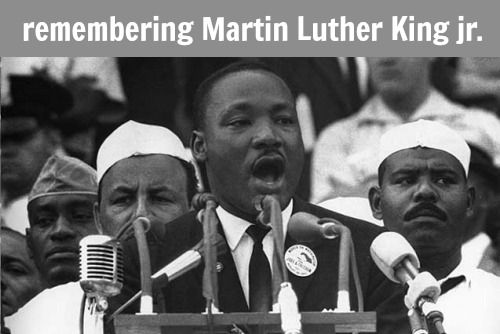
Teaching with Ticia: Remembering Martin Luther King Jr.


Photo source
Next Monday is Martin Luther King jr. Day, the day we've set aside to remember a man who changed our country.  I'm sure a lot of you are scrambling trying to find some great ideas for teaching about him to your kids or to your students.  Well, here are a few ideas to teach that I've found around the web recently, and I will use with my kids.


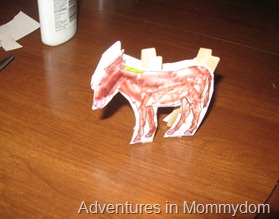
Learn about the mules and the people MLK thought were special at the Last Mules of Gee Bend

Some other ideas to add in:
for older kids: research Martin Luther, who he was named after, how are they similar?
watch the video of the speech, talk about his speech patterns, does he sound interested or bored?  Why do you think people listened to him?
this speech was delivered at the Washington Monument, learn about Washington's evolution of his views on slavery and brainstorm what Washington would have thought of Martin Luther King jr.?
before the speech is aired they sang spirituals, many were written by slaves for different reasons.  Listen to the songs.  Do they give you hope?  How do you feel after listening to it?  Are you angry?  Different songs brought different emotions to the slaves and later to the freed African Americans.

Tuesday, December 18, 2012

Teaching with Ticia: Helping Kids with Tragedy


I had a whole post planned in my head that I was going to write, and then events happened that changed it.  I don't want to draw further attention to the perpetrator, so this won't be specifically about Sandy Hook.  Besides tragedy happens in all guises.  There were tragedies in Hurricane Sandy, and there are smaller personal tragedies every day.  If you want a response to this tragedy in particular, read some of the links from yesterday's post.

I have dealt with this as a teacher with 9-11 and the next year when a shuttle crashed as it returned home.  I have dealt with this as a parent talking when their uncle died and then a year later when their grandpa died.  Both require patience and thinking before you speak.

Dealing with tragedy on a big scale, 

that doesn't affect you personally


1.  Correct errors they've picked up.  Kids will talk about it between themselves.  You can't hush it up and hide it because they will overhear things.  When the space shuttle Columbia crashed, the next day I had students come in claiming they picked up pieces of the space ship from their backyard.  A few even said there were aliens involved.  Correct misconceptions without being judgmental.
2.  Don't endlessly keep the news on when the kids are present.  This may seem like a no-brainer, but another one of the teachers in my school kept the news on to get more information about 9-11.  The principal had to make an announcement for TVs to be turned off.
3.  Allow them to talk.  Kids need ways to process.  Last fall (2011) there were fires near our home.  The kids and I listened to short news updates to know where the fires were.  We talked a lot about what we would do if the fires came to our house.  What the firefighters did to put out the fires.
4. Let them draw it out or act it out.  If their actions become violent, obviously that needs redirecting, but kids need to be able to get their emotions out.  Do not condemn them over their emotions.
5.  Read books to help them think through it.  Some good books are "I Never Saw Another Butterfly" (I only recommend this for uppper elementary or if you preview it), it's a book of poetry written by children in concentration camps.  They are going through horrid things, but the directors there let the kids write and draw. Another good one for hope in hard situations is "Fly Away Home," by Eve Bunting.  A father and his son are homeless and living in the airport.  It helps the kids see there is hope in hard situations, because the boy in the book has hope.

Dealing with tragedy on a personal level

1.  Most of what I said above applies again, but even more so.  Your kids will need to talk about this, and draw about it, and write about it.  Let them do it, even if it hurts you and makes you want to cry.  After their uncle died my boys spent 6 months drawing gravestones on everything.  They didn't go to the funeral, but they drew gravestones and ghosts on everything.  They suddenly had "ghost friends."
2.  To follow that, let them see you cry.  They need to understand you are hurting too.  It's okay.  Children are resilient, and they will get better if you give them the chance.
3. Keep a normal routine as much as possible.  Children thrive on routine, and it helps them to have a routine and to know what to expect.
4.  If it's a death in the family, think long and hard about taking the kids to the funeral.  For our family and our situation, it would not have been good for our kids to go to the funeral, for the both funerals the kids were too young.  They stayed with loving friends and did not go, but some kids it may help them to process their grief.
5.  Remember to talk about the event later on, it helps them remember and process things that happened long ago.  It also will help you.  Things hidden fester in you, and make it harder to recover.

Finally, here are several picture books about death I'm going to separate them out into ones about death of a pet and death of a person.  This is a list I collected back when I was teaching, and I have used some of these books in classrooms and some with my own kids.

Books about the death of a family member or someone you know


Books about the death of a pet or an animal

 
Finally I want to add one last book, Tear Soup, this is the one I read over and over when my Dad died during my first year of teaching.  I have given this book to several people to help them deal with their grief.  It's a great book in that it can help both grown ups and adults.

Tuesday, December 4, 2012

Teaching with Ticia: using classic texts


If you're familiar with the Charlotte Mason philosophy or Classical education you've heard of "living books," books that have stood the test of time and are still in print.  Books that have a wide ranging vocabulary.

I have to confess, I'm not always a fan of some of the examples they use as living books, but I do love good quality picture books.  I'm not a big fan of the Disney princess books or many other popular series for teaching from, though we do own quite a few books from that category.  I love books that have something outstanding in them.

Today my example of a living book is actually a reprint with new pictures.  It's also a Christmas book.  I bought this 10 years ago when I was teaching second grade.  Today I'm going to use this book with my kids (2nd grade and kinder) to demonstrate vocabulary and expressive language.  

When you're looking for good quality books, take the time to read it through.  Try reading the words out loud.  How does it sound?  Do the words just roll out of your mouth and make you smile to read them?  I love the Bear series from Karma Wilson.  I haven't read the books out loud to my kids for a while, but I can still quote parts of it.  

What's the vocabulary like?  Are all of the words one or two syllables?  Now there are exceptions, Cat in the Hat or Little Bear for example, but usually speaking if it's not a beginning reader and the vocabulary is that simple it's not going to stand the test of time.  When you're at the used book store do you pick up the copy of the TV show book you read as a kid to buy?  I don't, unless it's for nostalgia, or I've shown my kids that show.  Even then, my kids don't gravitate to that book over and over again.

What about the illustrations?  This is going to be a very subjective thing, but can you use the pictures for an art lesson?  "Tuesday" by David Weisner has almost no words, but it won a Caldecott.  The pictures told the story that well.  I've "read" it to my class or my kids and challenged them to create a similar style of book.  One that needs almost no words to tell a story.

Some ideas you can use from classic texts:

I'm a bit of a bibliophile, so I really enjoy older books.  They let me get a glimpse into a different age that you don't see now.

Tuesday, November 20, 2012

Seasonal writing: Letters to Santa


I'm sure you haven't realized this yet with all of the holiday music blaring and the stores telling you every few days, but Christmas is coming.

"What?" you say it's every year.  I know, I know it is.

But in all seriousness, Christmas is coming, and it's a great time to work on letter writing skills.

Back when I was teaching my class always wrote a letter to Santa, and he always wrote back to them.  It was a magical moment.  But, I want to share another way kids can write to Santa other than just what they really want.


When Santa Lost His Ho! Ho! Ho! is a super cute book with lots of great reasons to write letters.  Santa loses his "Ho ho ho," and is depressed.  Children write him hundreds of letters to cheer him up, but nothing works, until finally he gets that ONE letter.

Last year I read this book to my kids and then they spent a lot of time thinking of ways they would make Santa laugh.  Teacher Files has some cute Santa lined papers that would be great with this book and activity.

For early or pre-writers have them draw a funny cartoon.

All 3 of my kids are still at the early writing stages, so we concentrate more on process and how to create ideas.

So we brain stormed together what makes things funny.  Is it what you write or what you draw?  Why is one joke funny and another isn't?  After everyone had an idea we talked through if the idea needs a picture.  The letter that made Santa laugh in the book had a funny picture to go with it.  Did their funny idea need a picture to help explain it?

When they started writing I emphasize a lot that I do not care about spelling right now.  I want them to write.  My kids are worried about it being perfect.  I want them to get words on the page and then we can edit it for spelling or grammar.  This can be a very hard thing for kids to understand and grasp at a young age, but if they can get past wanting it to be perfect it can really help them be more willing to write on their own.

I'm always on the look out for other good books to lead into writing prompts, do you have some Christmas favorites for my kids to write about this year?

Tuesday, November 6, 2012

Teaching with Ticia: Arkansas and Michigan


ARKANSAS


Arkansas was a state that our library didn't have much on so in our personal studies we weren't able to do as much, but I have some fun ideas to tell you about afterwards.

Rosie's Fiddle- the state instrument of Arkansas is the fiddle, and I found this wonderful book about a fiddle.  Rosie challenges a visitor to a fiddling contest only to discover it's the Devil.  After reading the story we wrote down how we would win in a challenge against the Devil.

Arkansas Flag- Most state flags have specific reasons behind their creation, but I'm not always able to find the reason behind them.  In the case of Arkansas I was able to find some great resources on their state flag, and so we learned all about it and then made a flag to represent ourselves.

Diamond production- Arkansas is the only state in the contiguous United States that has a diamond mine, it's actually one of the big tourist draws for that state.  So we did a lot of talking about what you can make with diamonds, and then made our own "jewelry."

Other ideas
Hot Springs- there are natural hot springs that are a big draw.
Bill Clinton- honestly I didn't have a good book about him at our library, which was rather shocking to me

MICHIGAN


Clever Beatrice- a set of tall tales from Michigan, if your library has a copy I highly recommend getting these tall tales.  They're clever, well written, and highly entertaining.  After reading them we worked on puzzles and brain games.

Log Cabin Quilt- We don't tend to think of Michigan as a frontier state, but once upon a time it was, and this book is set during that time.  Most of the plot of this book revolves around chinking a cabin, filling in the empty space between logs.  For our activity we drew what our cabin would look like if properly chinked.

And that was the TWO books I could find, as I said my library had practically nothing for these two states, so we had 2 activities for each of them.  So, here's my other suggestions:

Make a car, Detroit is the car capital of the world
Kellogg's is based there.  You could poll your students for favorite cereals.  My kids don't like cereals which is why I didn't do this activity.
Ginger Ale was invented there.  You could make a homemade soda using water, dry ice and lots of flavoring of your choice, then compare it to the traditional sodas you buy.


What would you do to study Arkansas or Michigan?  These studies need some serious boning up, but my resources weren't able to do it, at least not without breaking my budget.


Tuesday, October 16, 2012

Teaching with Ticia: 5 Little Pumpkins


My kids are crazy about Halloween.  They love to think up costumes, they plan out decorations for our house for months.  They love the imagination and creativity behind it.

So, I always try to do lots of activities during Halloween, and one of my favorites when I was teach was "5 Little Pumpkins."  It's a fun cute poem that you can do many different activities with.

Art Project

Supplies needed: printable, orange paint or ink pad, markers

It's simple and fun.  On each page create a fingerprint pumpkin using paint or an ink pad and decorate for the words.  My kids enjoyed doing this and took the time to really decorate it all.

Math

This is one of many similar poems that are set up perfectly for some nice easy beginner subtraction.  Stuart J. Murphy has a book called "Monster Musical Chairs," that teaches the same principal.  After your art project is all done, go through and write the math problems for each page.  5-1=4, etc......

Reading

Go through each page and look for your sight words for the year. Circle them with crayon. If you have a multi-age class have them look for parts of speech, what adjectives are there?

Science

 Learn about pumpkins, how do they grow?  What is their life cycle?  Do they float?  Currclick has a great science unit that we used last year and the kids loved.  

Social Studies

Compare the Big Pumpkin to The Enormous Turnip.  How are they similar, how are they different.  Follow on Language activities, find synonyms for the word "big," and put them in order by size (big, giant, enormous, gigantic, etc).  You'll notice not everyone puts them in the same order.  Is there a right order for the words?

Tuesday, September 18, 2012

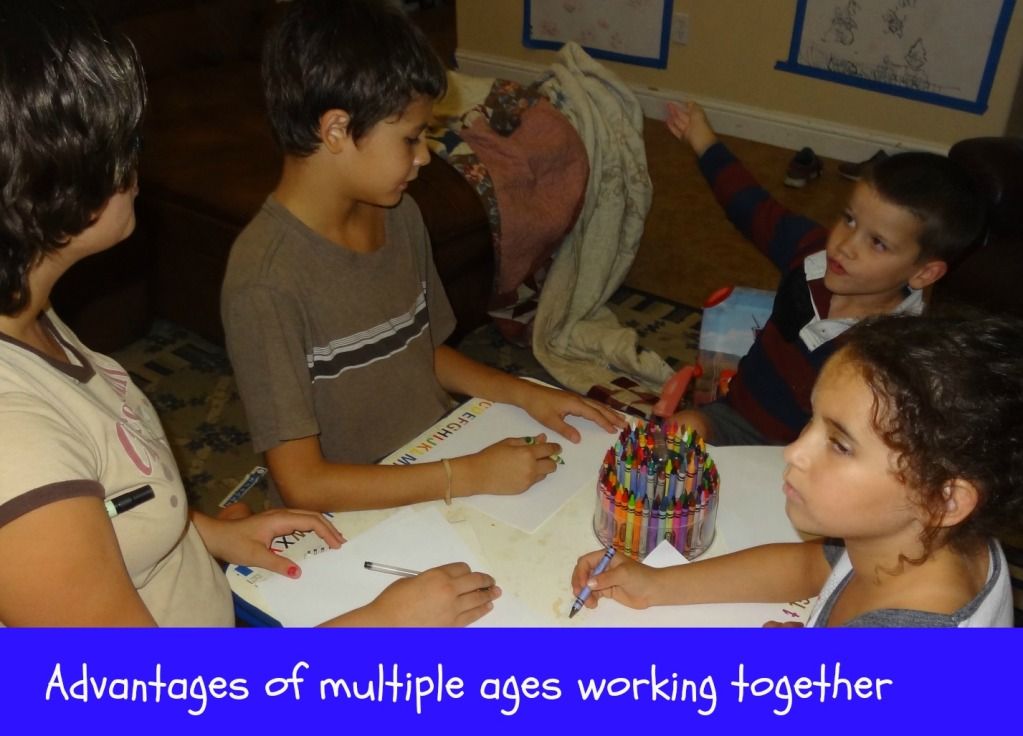
Teaching with Ticia: Mentoring Older and Younger kids together


This is one of those unspoken things we all know, but may not have thought of why it's a good idea.

I know when I was teaching (10 years ago) this was all the rage, pairing up an upper elementary classroom with a primary grade level.  In homeschooling, it tends to happen naturally because if you have more than one kid, chances are they are not all the same age.

But how can you best take advantage of it?  And what are the advantages?

Advantages for the Older Kid
1.  Chance to be the teacher.  We all know it's true for us, you learn a subject better if you have to teach it or model it.  The same is true for kids.
2.  Chance to be a role model.  Who do young kids most look up to?  The kids about 3 or 4 years older than them (as long as it's not their brother or sister).  5th graders are immensely cool to a 1st grader.
3.  Chance to be a leader.  Some kids are not naturally gifted at leading and when working in groups with their peers they won't lead.  This is a prime chance for them to step forward and LEAD!

Advantages for the Younger Kid
1.  They get to see what it looks like to be bigger and know more.
2.  Having a mentor who is more approachable than their teacher is.
3.  Learning from multiple people.  The more sources of information and input a child has the more the information will stick in their head.

What can you do together?
1.  The most obvious one: read together.  Let the younger kid get a chance to practice one on one, and let the older kid get a chance to practice reading a harder book out loud or reading with style.
2.  Science experiments.  There are many wonderful science experiments that you can do, that you may not want to do with a bunch of 5 year olds.  But, if you add in a more experience 9 or 10 year old suddenly that experiment looks much more doable.  Also this gives the older kid a chance to strut their stuff and build up excitement.
3.  Group projects.  Let the younger kids provide illustrations and help with presenting while the older kid does the writing and helps with research.  We did this for a homeschool co-op and both sides learned more than they would have on their own.

Have you ever had a multi-age group together?  What were your favorite activities?  What benefits do you see?

Monday, July 16, 2012

Teaching with Ticia: Hands on History

Yesterday at church one of my students told me history is boring.  I just about cried in frustration thinking all he is missing out on.

Then I realized it's because he's not being taught it right, and sadly many teachers fall into this trap because they didn't enjoy it either, so they try to do as little as possible with it.

So, to help any other kids from thinking history is boring, let me give you a few simple ideas to make it more interesting:

War of 1812
1.  Act out battles.  It doesn't have to be elaborate.  This battle is acted out using scrap fabric, figures from games, and empty boxes.  Acting it out gives you a better idea of what happened and how.


French and Indian War
2.  Show it on a map.  If they don't know where it happened or how it affects them, than it's useless to them.

Steps to the American Revolution
3.  Use props.  Many kids are visual learners, give them something to associate it with that isn't just a textbook.

Fountain of Youth
4.  Built it.  Build famous landmarks, build buildings, build maps.


5.  Watch it.  National Geographic has some amazing specials that are available on Netflix and many are age appropriate for early elementary.  Liberty Kids came out a few years ago and is an excellent show about the American Revolution.

6.  Visit it.  Almost every city I've visited has some sort of living history museum, or even just a history museum.  I'm lucky to live by 2 history museums, and 1 living history museum.  Go to them.  Talk to the enactors, talk to the docents, they'll have all sorts of interesting tidbits for you to think about.  Fun stories.

Ohio: Neil Armstrong
7.  Read it.  Find picture books and read them, find classic books and read them.  Do you know how we know about the French Revolution of 1832?  Primarily from Victor Hugo's novel "Les Miserables,"  How did we find the city of Troy?  Archeologists pieced together things from the Iliad to find it.  Books have amazing ways to engage us, and teach us so much while entertaining us.  Most of my geography posts are chock full of wonderful picture books with history in them.


Monday, July 2, 2012

Teaching with Ticia: Illinois and Alabama


Illinois


Illinois state symbols- we lost ours, since coop was at another house

Hog Music- 'A little girl is sent a birthday present by her aunt, along the way things are added to her present to make it truly memorable.'   After reading this we took the time to figure out what we would give her if we were sending a present cross country.  It has to pack well and not break while traveling a long way.  Our group came up with dolls, and hair ribbons, and the boys, of course, added in weapons.

Mr. Lincoln's Whiskers- 'A little girl writes a letter to presidential hopeful Abraham Lincoln encouraging him to grow a beard.'  We stopped the book half way through, right after the letter was written and each of the kids wrote what they would suggest Mr. Lincoln do.


Popcorn- Illinois is known for its popcorn, and so we tried an experiment with soaking popcorn kernels in different liquids to see which would pop best.


Other ideas I didn't cover due to lack of time and or books to read:

Barack Obama, Ronald Reagan (born in Illinois), Wild Bill Hickock, Field Museum, Great Chicago Fire, the first McDonald's, Oreo cookies


Alabama


Sadly, our library only really had anything about Rosa Parks, so our study was rather short for Alabama.

Alabama state symbol book

Rosa Parks- After reading about Rosa Parks we talked about small ways we can right wrongs.  Rosa Parks did by not standing up.  Then we talked about it.

Helen Keller- This is one of those great stories about not giving up.  If you have not read about Helen Keller, go out and read her life story.  She is incredibly inspirational, and as a little girl I read her life story over and over again.


Last Mule of Gee's Bend- Gee's Bend helped with the Civil Rights movement in a small, but very important way.  They provided the mules that helped pull Martin Luther King Jr's coffin.  For a while I thought about having them show a way to honor someone, but instead decided a craft was called for, so we made mules, to help us remember the mules from Gee's Bend.


Monday, June 18, 2012

Teaching with Ticia: Yankee Doodle


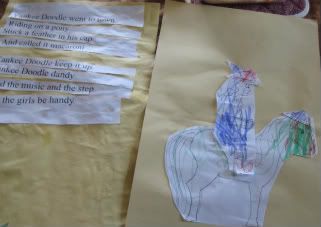
I love Yankee Doodle.  It's a fun song, it's easy to teach to kids, and there's history behind it.

I'm bringing this up because we're about to hit 4th of July and this is a great time to teach this song to our kids.  Ages ago, I wrote my first post about it with just the poem, here's a short mini-unit to do on this fun song.

LANGUAGE ARTS

1.  Look for the rhyming words.  Check out Mary Ann Hoberman's Yankee Doodle book.  It's a great example of making a parody of a rhyme and still keeping the original flavor.  What part of the rhyme is over the top and what parts could really happen?

2.  Look up what a macaroni is.  Write both a denotative (dictionary definition) and a connotative (your own words) definition.  It is a great way to truly internalize a word's meaning.


MATH

1.  Graphing- graph the vowels or choose a few consonants to graph.  It's a great exercise in prediction skills to think of which one will happen most frequently.

SOCIAL STUDIES

1.  Search for pictures of a "Macaroni."  Then draw what someone might look like today when we say "Macaroni."

2.  Read and find out the history behind the song Yankee Doodle.  Would you have been proud to be called a Yankee Doodle if you knew it was an insult?

COOKING

1.  Make hasty pudding like in the second verse of the song.

MUSIC AND MOVEMENT

1.  Yankee Doodle was nearly chosen for our national anthem.  Listen to "My Country Tis of Thee," "Star Spangled Banner," and "This Land is My Land."  All of these songs have been put forth at one time for a national anthem.  If you were choosing a song, what would you choose?

2.  Try marching in beat to the music.  Or play the game found here.

ART

1.  Make a newspaper hat and decorate it with feathers to make it a "Macaroni hat."
2.  Since this is a patriotic song, try making art using only red, white, and blue.  How does the picture turn out?  What color stands out most?  Try combining different mediums.  Does it change the artwork if you paint and then color with crayons?

What would you do with Yankee Doodle?

Monday, June 4, 2012

Teaching with Ticia: Indiana and Mississippi


Indiana

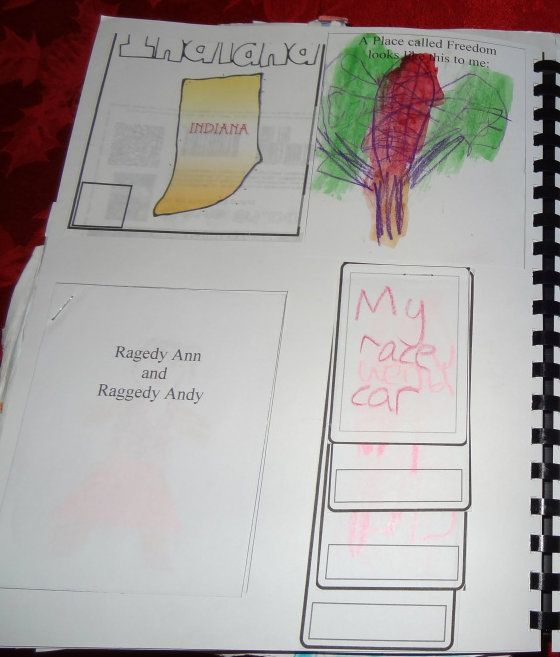
I always find research for these state studies interesting.  I find out all sorts of things, for instance Indiana is another of the states President Lincoln lived in.  Prior to starting researching I hadn't realized how much people moved around back then.  I had thought it was a recent trend, but apparently it's just in the DNA of our country.


What's in the lapbook:
Indie 500- I've found that giving kids a chance to build with Legos and learn at the same time is a guaranteed buy in from them.  The same was true this time as they built race cars and raced them.

A Place Called Freedom- This is a great story about the founding of Freedom, Indiana.  After reading we took the time to plan out what our perfect city would look like on paper.  If you have extra time, this would be a great time to pull out blocks and building supplies to design your town.

Raggedy Ann and Andy- I always wanted one, they're so cute.  We did a lot of talking about what our perfect doll would look like and then made some fun paper dolls.

Non-lapbook projects

Floating House- Prior to reading this book, I hadn't really thought about the different ways people might have traveled West, and after reading this we talked about it a little, but then we made boats to take home.


MISSISSIPPI
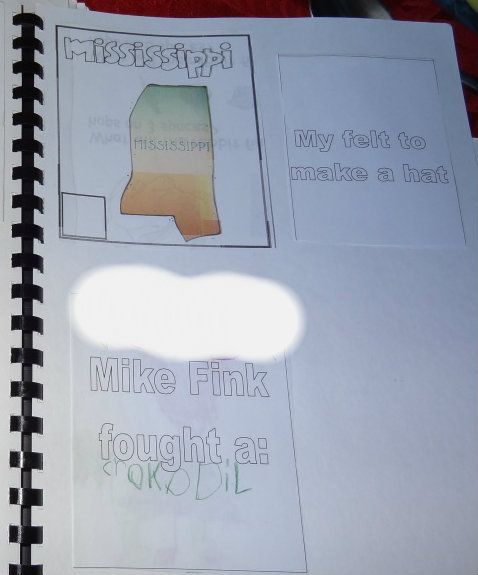
student name is blurred


Projects in the lapbook

Stetson hats- There are two different ways to go with this topic.  One would be to design your own hat for a specific purpose.  I decided to go with the science behind felting.  The kids all got a chance to turn some wool roving into felt, and discover it's not as easy as it looks.

Freedom School- During the Civil Rights movement many people came down South to teach the African Americans who hadn't been given equal schooling.  This is a great example of the bravery of everyone involved in that movement, and what a rich heritage we have because of the many cultures coming into our country.

Mike Fink- Tall tales are funny things, back in the 1800s an over the top braggart who is a bully was popular.  Now we read about him and think he's a bully and don't like him.  He does make for great discussion, though, and after reading it I challenged them to draw their own rendition of what he fought.

How Steam Engines work- When I think of Mississippi I think of steamboats.  But, how to make that into an activity for young kids?  Well, obviously you need to look at the science behind it.  Especially when you find a great video narrated by a seven year old.

Monday, May 21, 2012

Teaching with Ticia: Writing Centers


A few months ago I wrote a post about the portable writing center I designed, and it was wildly popular.  I realized that I'm not the only Mom or teacher who wants ideas on how to encourage writing.  I started researching and looking into more ideas and wanted to share a few things I figured out from that.

Provide a variety of writing materials

Pink and Green Mama shared her portable center and it had many different pens, markers, crayons, pencils.  I've found that the more things available to write with, the more they will write.

Try different sensory experiences.  Try writing in paint, or my personal favorite shaving cream (it cleans the surface your writing on, I used this all the time while teaching).  Dry erase boards also make a great place to practice.

Set up a permanent space

If you have the ability and wall space (this is great in a classroom, it was my most visited center).

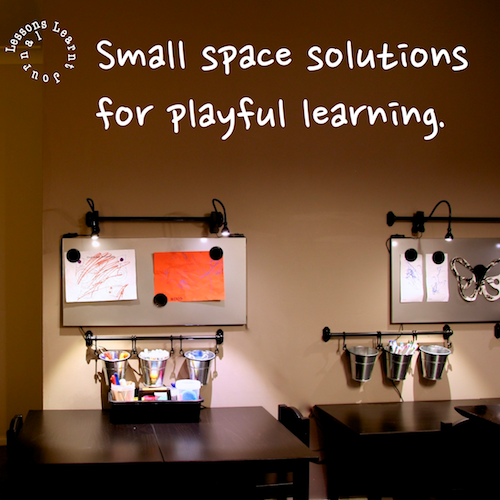
Lessons Learnt Journal shared how she set up her area, along with where she got everything.  I've found in my various experiments less is better, because it forces them to think it through more.


Provide many different things to write on

If you look at my picture up above you see all sorts of different cards in there.  Other great things to leave in there:  note pads with funny pictures, those little pads of paper given away as freebies, old stationary, construction paper, scrapbooking paper you're not going to use.

Fun things to add: stickers, magazines, pre-made books, writing prompts, examples of correct writing form

Writing Ideas board-some more ideas of activities, things to do

Do you have anything to add?  Did you write a post about writing or a writing station?  I'd love to add it to my writing board or come back later and add it to this post.


Thursday, May 17, 2012

Teaching with Ticia: Louisiana


Louisiana is a fun place to study.  There is a lot of history, culture, and art to look at there.  It's also a fun place to visit, which I discovered last spring when I spent a day or so driving through there.


What's on here:
My plan to save the levies- One of the things we talked about is the devastation Katrina had on New Orleans, and how we can work to prevent that.  We talked through it, but since it was mostly talking I don't have any picture to go for that activity.

Down in Louisiana- I discovered a great Louisiana author who has several books set in various parts of Louisiana, this first one is "Down in Louisiana," a twist on a traditional song.  The book is made in collage style and I encourage the kids to create a collage of different animals mentioned.  They didn't always go with my plans and instead opted to draw their creations.

Chef Creole- This is an imaginative book using food from Creole culture to create a person.  Again this book was done in collage style, and many of the kids opted to make collages, however this child did not.  So, if you want to see other examples go to the full post.

The Blues music- I found a fun retelling of Bremen Town Musicians as the "Ol' Boogie-Woogie Blues Bayou," and my kids thoroughly enjoyed it.  When paired with a blues song from Fantasia 2000, it led to a fun experiment in art.  I have to say, any time I get to pull Gershwin music into school work is a win for me.

Other things not included in the lapbook because they were lost or misplaced:

Mardi Gras masks, a great excuse to make costumes.  Little Wonder Days also has some fun Mardi Gras posts with a mask idea and a yummy looking cookie.

State symbol book- I had fun pulling some ideas from the state symbols with Louisiana.

Crawfish- I always love to compare what is real in a fiction book with what isn't.

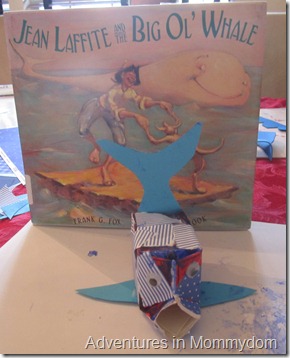
Jean Laffitte and the Big Ol' Whale- This was a fun opportunity to throw in some art projects.  There's apparently several tall tales about this pirate, and he also participated in........

The Battle for New Orleans- which features Andrew Jackson from Tennessee.  If I was writing this post a week later, I'd have a better post to link to about that battle, but we just finished doing our War of 1812 activity Friday.

And finally, I found this post amongst my pins and bookmarks about Louisiana, All Things Beautiful is working her way through the states and has a different take than I do on it, she does more cooking, and you have to try some of her recipes.

Books Read:


Monday, April 16, 2012

Teaching with Ticia: Making the Most of Field Trips


Spring is field trip season. The weather is beautiful, and many of my local area places are best in the Spring. So, we at least in our homeschool go on lots of field trips in this time of year.

Prep work before 


1. Look to see hours, distance to travel, and other things of that nature. I've made the mistake a few times of not checking ahead of time and getting there to discover the place we were going closed.

2.  Check to see if there's a website.  If there is look for any lesson plans to go along with it.  Many museums or zoos have lesson plans to go with their museum.  They also frequently have picture scavenger hunts for younger kids to complete.

3.  Pack all snacks and lunches you plan to bring.  Double check if you can bring them in.  Some museums allow you to bring small snacks, others do not allow any food inside, but will allow you to leave to eat and come back in.

4.  If it's a museum dedicated to someone, or someone's house, try checking out a book about the subject to let them learn more beforehand, and to bring up more questions.

While you're there


1.  Take advantage of maps.  This is a great chance to have a hands on map skills lesson.


2.  Figure out what places are high priority and go there first.  For my kids when we go to zoos, their highest priorities are giraffes and lions.  Children's Museums, their highest priorities are the grocery stores or towns.  Most other museums it is hands on exhibits.


3.  I'm sure you all know this, but if it's just your family and you are not on a particular schedule, leave while the kids are still happy.  It's so tempting to squeeze out one more activity to "get your money's worth out of it," but every time I've tried that it has not gone well.

4.  If it is not a museum geared towards children, try to alternate exhibits that are less hands on and exhibits that are more hands on.

After the field trip


1.  For younger kids, have them narrate what happened, and what their favorite parts were.  Older kids who are starting to write can write their own summary.

2.  Do any follow up activities suggested from the website.  Our local children's museum has suggestions of what to do after your visit related to the current traveling exhibit.  Depending on the type of exhibit it can be a science experiment, a writing activity, or a building activity.

3.  Go to the library and follow up on any topics or questions brought up.  We frequently follow up zoo visits by getting more information about animals we saw.

4.  Write a story.  This is one of my kids' favorites activities to do.  They will spend a lot of time making up stories about them and the pictures we took.

Monday, April 2, 2012

Teaching with Ticia: Ohio and ways to use the state symbols books


I was going to post on Ohio and Louisiana, but there were a lot of activities and books to go with Louisiana, and that would make this post extremely long, beyond my attention span..........

OHIO
First a sign language joke (I took 2 years in college), the sign for Ohio is "O" move your "O" higher.  That may only amuse me, but it certainly amused me very much.

Included in the lapbook:

My Great Invention- Ohio is home to the "Invention Museum," which I would love to visit someday!  I found a book called "Cromwell Dixon's Sky Cycle," all about a boy who loves to invent things.  With my kids we created an invention with Legos, however this would also be a great time to break out your box of recyclables and let them create whatever they want.  This activity lets you pull in several different disciplines (science-making a plan and experimenting, writing, what are your steps and how did you do it, math- measuring).

Covered Wagon- Early on Ohio was considered the "Great Wilderness," and it was brave to explore out there.  We tend to think of wagon trains to Oregon or somewhere "out West," but once upon a time this was great wilderness.  We had to fill our covered wagons with pictures of what we would bring.  I tried to size it appropriate to the space, but that did not always work right.

Neil Armstrong- Neil Armstrong is from Ohio, and the book I found wrote all about how he planned and worked to achieve his plan of being a pilot and then an astronaut.  I challenged the kids to think of what their goal is and how they would achieve it.


Other things to do:
Trilobites- the state fossil.  Afterwards I did a few google searches and found these ideas: trilobite masks and printable 3d trilobite and snack.  Trilobites are on my things I find oddly amusing list.

Giant of Seville- This is a cute story about a small town, Seville, that helps a VERY tall man feel welcome in their town despite his not fitting any of the houses or buildings.  A great story to talk about accepting people who are different than you, and how to work to help them fit in.  An easy extension of this book is to measure out how tall the giant was and compare it to themselves.

Annie Oakley- my library had several books on her, but it did not work on the flow of our lesson to include her.  I highly recommend reading a book about her and then comparing it to the musical about her "Annie Get Your Gun!"  If you have boys with Nerf guns this would be a great chance to let them practice hitting targets like she did (toilet paper rolls make great targets).


Warm as Wool- You can use this an introduction to spinning wool, I found a great series of videos on this starting with "How a spinning wheel works."


What to do with State Symbol books

Graph them, this is the easiest thing to do with them.  I joke that every third state has a ladybug as their state insect and the other two are either a butterfly or firefly.  But, it makes for an interesting comparison.  What is the most common state insect or flower?

Sort into classifications- Does every state have a state flower or fossil?  Which states have what symbols?

Compare and Contrast- Venn Diagrams would be a great idea here.  You can compare two neighboring states and see if they share any common symbols.

What would you do with them?  I'm planning on graphing them, but I think we might go back and do a Venn diagram as an easy pictorial introduction.

Monday, March 19, 2012

Teaching with Ticia: Using Legos in your school


Legos have many uses in classrooms.  Aside from just being fun to build with and great for spatial reasoning, there are also many ways you can use them in your classroom or home as a learning experience.

The most common way we use them in our school work is to reenact stories, history lessons, or Bible stories.
All you have to do is have a large collection of figures and various other Legos to be able to build the story and act it out.  Fun, simple, and a great way to get that story in your memory.

Another advantage of Legos is problem solving and figuring out how to "make it work."  Pose problems to solve using the Legos.  For example, Bob has a garden and wants to plant red, yellow, blue, and orange plants.  He can't put the red next to the orange plants, how can he plant them best?

Legos are also great for inventing things.  Can you make an air vehicle?  If you were to create a boat what would be on it?  What is the fastest race car you can make?
If you're just using them for a bit of "educational fun" just have at it.  To make it a bit more of a learning experience and to force them to slow down and think it through, have them draw out their steps or what is required of it.

This put a little more thinking in their processes, and also if you're trying to keep standards (in Texas they're called TEKS), adds in a writing component to you history, science, or logical thinking activity.

And finally, another great method: math.  You can use them as a fun manipulative for teaching different math problems.

Count the bumps on them, add the bumps on the pieces together, find the area, find the perimeter.  The ideas are endless.  This is one I'm thinking of using with my kids as we travel in a month or so.

Have you ever used Legos as a learning tool?  What are your favorite ideas?